

I am writing to correct several factually incorrect statements included in Mark Reaman’s editorial and letters to the editor, published on January 9, 2026 in the CB news and published on December 24, 2025 in the Gunnison Country Times regarding the “Clean Heat Plan”. I also ask you, as the reader, to be mindful when information is shared that aggressively attacks climate-related legislation, programs, and policies. While it may be tempting to label all climate-related
work as “too expensive” or “not impactful,” this framing overlooks the full story. Climate solutions are complex and nuanced, but when designed thoughtfully, they almost always have the potential to deliver both environmental and economic benefits.
Factually incorrect statement 1: “And right now, natural gas is considered to actually be cleaner than electricity which is generated not just by solar but also coal.”
Data shows that using electricity is cleaner than natural gas (or gasoline, for that matter). Our electricity comes from GCEA, which purchases power from Tri-State. As of 2026, Tri- State’s resource mix was approximately 36% utility-scale renewables, 2% member renewables, 50% fossil fuels (natural gas and coal), and 12% market contracts—primarily from WAPA, which is largely hydropower. When weighted together, this mix results in a carbon intensity for electricity that is lower than that of natural gas. This means that using electricity is cleaner
than using natural gas and will continue to be.
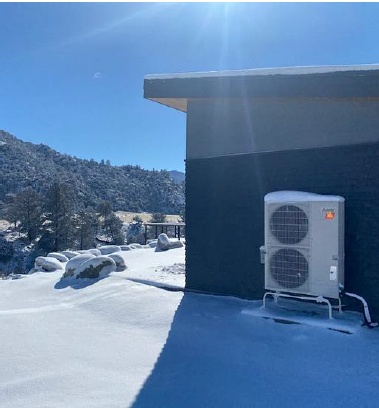
Additionally, cold-climate heat pumps—the equipment used under a Clean Heat Plan—operate at effective efficiencies of roughly 300–400%. Fossil-fuel combustion equipment will never exceed 100% efficiency. This means we need far less energy input to deliver the same amount of heat. From a carbon perspective, heat pumps win. (So do electric vehicles, by the way.)
Factually incorrect statement 2: Paraphrased: Electricity prices will increase because of electrification.
A previous letter outlined the real reasons electricity rates are rising, and these cost increases are not connected to electrification proposed for the future. Per the U.S. Energy Information Administration), the primary driver of rising electricity prices is increased wholesale natural gas costs (see above, we use natural gas to generate electricity). Other contributors include inflation, the rapid growth of data centers to support AI, and costs associated with responding to
extreme weather events driven by climate change.
Incomplete and misleading statement 3: “Cost to homeowner to convert to all electricity, $30–$70K”
Industry experience strongly suggests these figures are not representative of most projects. If bids at this level are being reported, it warrants a closer look at why incremental heat pump costs appear unusually high and how those costs might be reduced.
Best practice is to replace heating, cooling, and ventilation equipment when it reaches the end of its useful life. While many reports show that heat pumps can have a higher incremental cost than gas systems, these costs are typically far below $30,000–$70,000 and are often projected to be under $10,000—or even near cost parity. It is also important to note that a heat pump provides
both heating and cooling. When replacing a gas furnace with a cold-climate heat pump, homeowners are also gaining an efficient air conditioner, which helps explain some of the added cost.
Additionally, if electrification offered no benefit, why would organizations that advocate for low-and moderate-income households support the Clean Heat Plan? For example, Christo Luna, Deputy State Director for Mi Familia Vota, stated:
“Mi Familia Vota applauds the PUC’s strong Clean Heat targets. Cutting emissions 41% by 2035 is a meaningful win for Latino and working-class families who deserve clean air, lower energy bills, and healthier homes. This decision moves Colorado closer to an equitable transition away from fossil gas, and we’ll continue advocating for climate solutions that protect our communities and our future.”
There is a clear disconnect between some of the claims being made and real-world industry experience. HVAC pricing varies widely based on contractor expertise, system familiarity, existing conditions, subcontractor rates, manufacturer selection, and even contractor ideology.
Without studying the local market, it is premature—and inaccurate—to assert what actual costs will be.
Factually incorrect and/or misleading statement 4: “Now it’s easy to understand why GCEA wants to charge 7x the normal rate for peak hour usage.”
I cannot determine the basis for this statement. GCEA’s 2026 rates can be viewed here:
https://www.gcea.coop/wp-content/uploads/Rate-Chart-2026.pdf. Under GCEA’s optional TOU rates, the energy charge varies based on when electricity is used—higher during on-peak hours and lower during off-peak hours.
When customers analyze their usage under a traditional and TOU rate structure, many find that TOU rates are actually less expensive overall. TOU pricing is designed to encourage load shifting so utilities can avoid building new power plants or investing in additional infrastructure.
This approach benefits both customers and the broader system. GCEA has not expressed interest in raising rates due to electrification.
Join us
If you would genuinely like to better understand climate-related work, we invite you to engage with us — gunnisonvalleyclimate@gmail.com. We would be happy to welcome you to a GVC3 meeting and share data, industry experience, and research-based insights. We are not politically motivated—we are driven by a desire to do right by the plan and the people who live here.
Emily Artale, PE, Energy Engineer and Sustainability Consultant
Member
Gunnison Valley Community Climate Coalition (GVC3)


